



When a chiral centre has to be set reliably, many process chemists still reach for an Evans auxiliary. 4-Phenyl-2-Oxazolidinone is one of the most widely used of these auxiliaries, and both of its enantiomers have become important again now that oral GLP-1 medicines such as orforglipron are moving into European markets. This guide covers the (S) and (R) forms, how they work, where they are used, and what European buyers should check before ordering.
What Is 4-Phenyl-2-Oxazolidinone?
4-Phenyl-2-Oxazolidinone (C9H9NO2, MW 163.17) is a five-membered cyclic carbamate carrying a phenyl group at the 4-position. It is normally made from enantiopure phenylglycinol, so each enantiomer reflects the configuration of that starting amino alcohol. Both forms are white crystalline solids that melt at roughly 129–133 °C.
It belongs to the family of Evans oxazolidinone auxiliaries, alongside the 4-benzyl and 4-isopropyl analogues described in Sigma-Aldrich’s overview of oxazolidinone chiral auxiliaries.
How the Evans Auxiliary Works
The auxiliary is used in three simple stages:
- Attach: the nitrogen is acylated with the acid you want to functionalise, giving an N-acyl oxazolidinone.
- React: the bulky phenyl group blocks one face of the enolate, so alkylations, aldol reactions and conjugate (1,4-) additions take place with high diastereoselectivity.
- Remove and recover: the auxiliary is cleaved (for example with LiOH/H2O2 or a reducing agent) and can be recovered and reused, which helps process economics.
Because the stereochemistry comes from the auxiliary, choosing the correct enantiomer decides which enantiomer of the product you get.
Two Enantiomers of 4-Phenyl-2-Oxazolidinone We Supply
1. (S)-(+)-4-Phenyl-2-Oxazolidinone (CAS 99395-88-7)
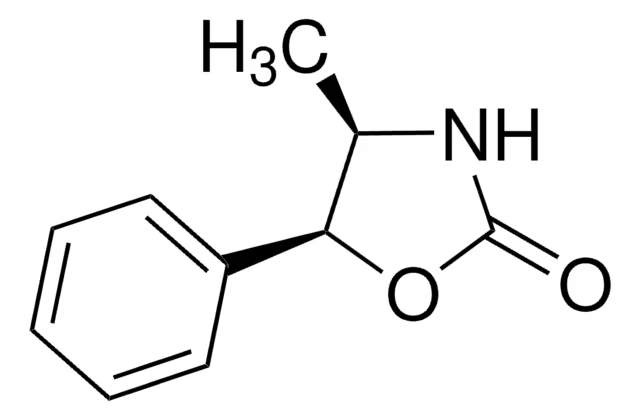
The (S) enantiomer shows a positive specific rotation of about +48° (c = 2, chloroform). It is best known in industry from the published ezetimibe routes, where it controls the side-chain stereocentre before the azetidinone ring is formed. It is also widely used in academic and CDMO work for asymmetric alkylation and aldol chemistry. View (S)-4-Phenyl-2-Oxazolidinone details.
2. (R)-(−)-4-Phenyl-2-Oxazolidinone (CAS 90319-52-1)
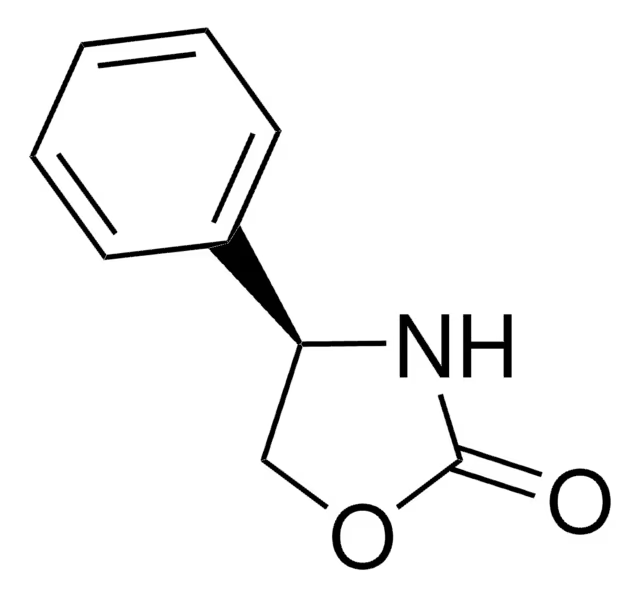
The (R) enantiomer is the mirror image, with a rotation of about −48° under the same conditions. It gives the opposite product configuration and is described in the literature as a synthon for α-amino acids and β-lactam antibiotics. Interest has grown with orforglipron: a 2025 paper in Organic Process Research & Development describes an Evans auxiliary-assisted asymmetric 1,4-addition route to a key indole intermediate. View (R)-4-Phenyl-2-Oxazolidinone details.
4-Phenyl-2-Oxazolidinone: Quick Comparison
| Property | (S)-(+) Enantiomer | (R)-(−) Enantiomer |
|---|---|---|
| CAS No. | 99395-88-7 | 90319-52-1 |
| Specific rotation | approx. +48° (c 2, CHCl3) | approx. −48° (c 2, CHCl3) |
| Melting point | 129–132 °C | 131–133 °C |
| Typical use | Ezetimibe-type routes, aldol and alkylation chemistry | Amino acids, β-lactams, GLP-1 programme chemistry |
Why European Demand Is Rising
In August 2026 the UK MHRA became the first regulator in Europe to authorise orforglipron (Foundayo), an oral, non-peptide GLP-1 receptor agonist, as reported by The Pharmaceutical Journal. Small-molecule GLP-1 programmes rely on classical asymmetric chemistry, which keeps demand for dependable chiral auxiliaries strong among European CDMOs, generic developers and research groups.
What to Check Before Buying 4-Phenyl-2-Oxazolidinone
For a chiral auxiliary, optical purity matters as much as chemical purity. European quality teams typically ask for:
- Enantiomeric excess: chiral HPLC data showing high ee, since any opposite enantiomer lowers diastereoselectivity downstream.
- Specific rotation and melting point: checked against the specification on every batch.
- Chemical purity and residual solvents: HPLC assay plus GC-HS data.
- Consistent documentation: CoA, SDS and a short route summary for supplier qualification.
- Scalable supply: the ability to move from sample to kilogram lots without changing the process.
Why Source from Lifechem Pharma
Lifechem Pharma has manufactured specialty chemicals and advanced intermediates in India since 2015. We hold ISO 9001:2015, ISO 14001:2015 and ISO 45001:2018 certification, and our QC laboratory releases every batch using HPLC, GC-HS, FTIR and UV spectrophotometry. We also offer related auxiliaries such as (R)-4-Benzyl-2-Oxazolidinone, and you can read more in our Orforglipron intermediate supplier guide.
Frequently Asked Questions
What is the difference between (S)- and (R)-4-Phenyl-2-Oxazolidinone?
They are mirror-image enantiomers with the same physical properties but opposite optical rotation. Each one delivers the opposite configuration in the final product.
Which enantiomer should I choose for my route?
Work back from the target stereocentre. Your published or patented route will state which auxiliary it uses, and switching to the other enantiomer will give the opposite product. If you are developing a new route, run small screening reactions with both forms before you fix the specification and order larger quantities.
Can the auxiliary be recovered?
Yes. After cleavage it can usually be recovered and purified for reuse, which lowers cost at scale.
Do you ship samples to Europe and the UK?
Yes. Share your quantity and specification and we will confirm lead time, packaging and documents.
Conclusion
Whether your route needs the (S) or the (R) form, 4-Phenyl-2-Oxazolidinone remains a proven, recoverable way to control stereochemistry at scale. Lifechem Pharma supplies both enantiomers with full QC documentation for European and UK customers. Contact our team for samples and a quotation.
Recent Comments