
Nilotinib Intermediates: 4 Proven Building Blocks Behind Tasigna Generics
Nilotinib intermediates explained: the classic synthesis route, key CAS numbers and 4 proven amino ester and guanidine building blocks made in India.
Since generic versions of Tasigna® began reaching the market, including Nilotinib Accord in the EU in August 2024 and the first US generic in 2025, demand for reliable nilotinib intermediates has grown quickly. For API developers, CDMOs and generic R&D teams in Europe, the UK and India, the first sourcing question is simple: which building blocks to qualify, and from whom. This guide explains how nilotinib is made, lists the key intermediates with their CAS numbers, and shows the four we manufacture in India.
What Is Nilotinib and Why Nilotinib Intermediates Matter
Nilotinib is a second-generation BCR-ABL tyrosine kinase inhibitor developed by Novartis. It is used to treat Philadelphia chromosome-positive chronic myeloid leukaemia (Ph+ CML) in the chronic phase, including patients who are resistant to or intolerant of imatinib. Structurally it is a 2-anilinopyrimidine amide (PubChem CID 644241), which means most of the molecule is assembled from a small number of well-defined building blocks.
Under ICH Q11, GMP controls begin at the starting materials you declare in the dossier. Well-characterised intermediates with a consistent impurity profile make that justification easier, reduce questions from EMA, MHRA or CDSCO assessors, and protect the yield of every downstream step. A poor supplier choice at this stage is expensive to fix later.
Nilotinib Synthesis: The Classic Novartis Route
The original Novartis route, reviewed in detail in Organic & Biomolecular Chemistry (2013), is convergent. A pyrimidine fragment and an aniline fragment are built separately and then joined by an amide bond:
- Guanidine formation: ethyl 3-amino-4-methylbenzoate reacts with cyanamide to give ethyl 3-guanidino-4-methylbenzoate. It is isolated as the nitrate salt, which is poorly soluble and easy to collect by filtration.
- Enaminone formation: 3-acetylpyridine is condensed with DMF-DMA to give 3-(dimethylamino)-1-(pyridin-3-yl)prop-2-en-1-one.
- Pyrimidine ring closure: the guanidine and the enaminone cyclise to the 2-anilinopyrimidine ester, ethyl 4-methyl-3-[[4-(pyridin-3-yl)pyrimidin-2-yl]amino]benzoate.
- Hydrolysis: the ester is hydrolysed to the key nilotinib acid, 4-methyl-3-[[4-(pyridin-3-yl)pyrimidin-2-yl]amino]benzoic acid.
- Amide coupling: the acid is coupled with 3-(4-methyl-1H-imidazol-1-yl)-5-(trifluoromethyl)aniline, originally with diethyl phosphorocyanidate and in later processes through the acid chloride, to give nilotinib base.
Later Novartis work showed that the methyl ester can be condensed directly with the aniline using potassium tert-butoxide, which removes the hydrolysis and activation steps. That is why both the ethyl and the methyl versions of these nilotinib intermediates are in demand.
Nilotinib Intermediates List with CAS Numbers
The table below lists the main nilotinib intermediates used in the classic nilotinib synthesis, with their CAS numbers and the step where each one is used.
| Intermediate | CAS No. | Role in the Route | From Lifechem |
|---|---|---|---|
| Ethyl 3-amino-4-methylbenzoate | 41191-92-8 | Starting amine for the guanidine | Yes |
| Methyl 3-amino-4-methylbenzoate | 18595-18-1 | Starting amine, methyl ester route | Yes |
| Ethyl 3-guanidino-4-methylbenzoate nitrate | 641569-96-2 | Guanidine for pyrimidine ring closure | Yes |
| Methyl 3-guanidino-4-methylbenzoate nitrate | 1025716-99-7 | Guanidine, methyl ester route | Yes |
| 3-(Dimethylamino)-1-(pyridin-3-yl)prop-2-en-1-one | 55314-16-4 | Enaminone partner for the pyrimidine | On enquiry |
| Ethyl 4-methyl-3-[[4-(pyridin-3-yl)pyrimidin-2-yl]amino]benzoate | 641569-97-3 | Pyrimidine ester | On enquiry |
| 4-Methyl-3-[[4-(pyridin-3-yl)pyrimidin-2-yl]amino]benzoic acid | 641569-94-0 | Acid for the final amide coupling | On enquiry |
| 3-(4-Methyl-1H-imidazol-1-yl)-5-(trifluoromethyl)aniline | 641571-11-1 | Aniline fragment | On enquiry |
The 4 Nilotinib Intermediates We Manufacture
All four nilotinib intermediates below sit at the very start of the pyrimidine fragment. They are made in our own plants at Panoli GIDC, Ankleshwar, and every batch is released by our QC laboratory.
1. Ethyl 3-Amino-4-Methylbenzoate (CAS 41191-92-8)
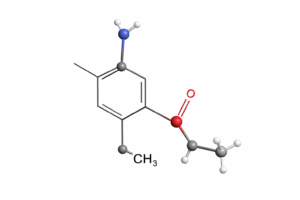
This aromatic amino ester is the classic starting amine of the Novartis route. Its amino group is converted into the guanidine, while the ethyl ester is carried through to the pyrimidine ester and later hydrolysed. We supply it at ≥98% (HPLC) as a pale yellow to off-white crystalline solid. Buyers usually focus on assay, the 4-amino-3-methyl positional isomer and residual nitro precursor. View Ethyl 3-Amino-4-Methylbenzoate details.
2. Ethyl 3-Guanidino-4-Methylbenzoate Nitrate (CAS 641569-96-2)
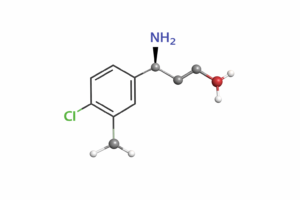
This guanidine salt reacts with the pyridyl enaminone to close the 2-anilinopyrimidine ring, the key ring-forming step in nilotinib synthesis. Buying it ready-made saves a cyanamide step at your site and gives you a stable, easy-to-handle solid. Our grade is ≥99% (HPLC), white to off-white crystalline powder, with controlled residual cyanamide and urea-type by-products. View Ethyl 3-Guanidino-4-Methylbenzoate Nitrate details.
3. Methyl 3-Amino-4-Methylbenzoate (CAS 18595-18-1)
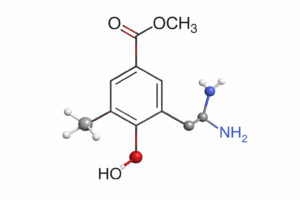
The methyl ester is the starting amine for processes that use the methyl pyrimidine ester and couple it directly with the aniline. It is also a versatile building block for other kinase inhibitor programmes. We offer it at ≥98% (HPLC) as an off-white to light yellow crystalline solid. View Methyl 3-Amino-4-Methylbenzoate details.
4. Methyl 3-Guanidino-4-Methylbenzoate Nitrate (CAS 1025716-99-7)
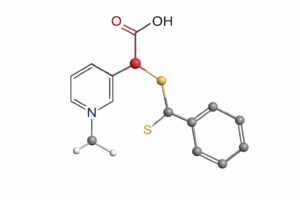
This is the methyl counterpart of the guanidine nitrate. It cyclises with the enaminone to give the methyl pyrimidine ester, which suits the direct ester-to-amide coupling. We supply it at ≥99% (HPLC) as a white to off-white crystalline powder. View Methyl 3-Guanidino-4-Methylbenzoate Nitrate details.
What to Check Before Qualifying a Supplier
Before approving any source of nilotinib intermediates, quality teams in Europe, the UK and India usually review these points:
- Documentation: a CoA with HPLC purity and identity data, an SDS, and a route-of-synthesis summary to support your starting-material justification.
- Impurity control: positional isomers, residual cyanamide, nitrate content and residual solvents, with a mutagenic-impurity assessment in line with ICH M7.
- Batch consistency: results from several batches, not just a single sample.
- Scale-up readiness: the ability to move from gram samples to multi-kilogram lots without changing the route.
- REACH and logistics: for EU imports, agree early how REACH obligations will be handled and confirm the packaging suits your site.
Why Source Nilotinib Intermediates from Lifechem Pharma
Lifechem Pharma has manufactured specialty chemicals and advanced intermediates in India since 2015. Our operations are certified to ISO 9001:2015, ISO 14001:2015 and ISO 45001:2018, and our QC laboratory releases every batch on HPLC, GC and KF data. A CoA and SDS are shared with every quotation, and we supply from gram samples to commercial quantities for customers in Europe, the UK and India.
You can also browse our full range of advanced intermediates, or contact our team for samples, pricing and technical documents.
Frequently Asked Questions
What are the main intermediates in nilotinib synthesis?
The classic route uses ethyl 3-amino-4-methylbenzoate, its guanidine nitrate, the pyridyl enaminone, the pyrimidine ester and acid, and 3-(4-methyl-1H-imidazol-1-yl)-5-(trifluoromethyl)aniline. Your final starting-material designation depends on your own route and regulatory strategy.
Why is the guanidine isolated as a nitrate salt?
The nitrate salt crystallises well and is poorly soluble, so it can be collected by simple filtration in high purity. It is also more stable to store and ship than the free guanidine base.
Should I choose the ethyl or the methyl ester?
Choose the ethyl versions for the classic hydrolysis-and-coupling route, and the methyl versions if your process couples the methyl pyrimidine ester directly with the aniline. We supply both.
Do you ship samples to Europe and the UK?
Yes. Share your quantity and specification, and our team will confirm lead time, packaging and documents for delivery to your site.
Conclusion
Reliable nilotinib intermediates are the foundation of a robust API process and a smoother regulatory filing. With both the ethyl and methyl amino esters and guanidine nitrates available from one ISO-certified manufacturer, Lifechem Pharma helps generic developers in Europe, the UK and India cut supply risk from the first gram to commercial scale. Request a quote today.